The sheer number of available offshore entity options may overwhelm many individuals when considering using an offshore structure for the first time. While there exist several jurisdictions that emphasize a particular aspect (i.e., tax efficiency, privacy, etc.) or combination of aspects of such entities (e.g., asset protection and privacy), relatively few jurisdictions have managed to provide a solution with all three in one package where each is both practical and capable of providing strong legal support. The jurisdiction of Nevis, however, has gained credibility for its ability to provide individuals seeking higher levels of asset security with greater asset security while reducing the complexity associated with the use of offshore structures.
Unlike other offshore tools, a Nevis trust is a legal structure established within a legal system designed to provide flexibility and protection. Understanding how the various components of a Nevis trust operate, as well as the rationale behind their design, will allow investors, entrepreneurs, and family offices managing wealth across multiple geographic locations to determine whether using this type of trust should be part of their broader planning strategy.
Key Takeaways
- Trusts in Nevis are among the most common offshore asset protection structures. They offer a number of protections against creditor claims and potential litigation.
- The Nevis trust laws create multiple barriers for a creditor (in terms of process) before they can even challenge a trust. There are very specific laws that also apply to recognizing foreign judgments.
- A Nevis trust is able to provide ongoing support for protecting your long-term wealth through estate planning and succession planning, especially if you own property internationally or have other cross-border interests.
- Many clients choose to use both a Nevis trust and a Nevis limited liability company to create a two-tiered corporate structure that separates ownership from management and provides an additional layer of asset protection.
- While a Nevis trust represents a tax-neutral environment for many non-residents, there will be reporting and/or tax implications associated with owning such a trust, depending upon the residents' local taxing authority, and the residents should consult with their tax professional.
What is a Nevis Trust?
A Nevis Trust is an offshore trust that utilizes the law of Nevis in order to create a separate legal trust, as defined under the Nevis International Exempt Trust Ordinance (NIETO).
The NIETO was enacted to provide a general statutory framework for regulating all international trusts while also offering flexibility for both non-resident clients and their advisors.
Similarly, a Nevis trust requires the transfer of assets from an individual or entity (the settlor) to a trustee, who will then manage the transferred assets pursuant to the express terms of the trust deed for the benefit of designated beneficiaries.
This separation of assets from the settlor creates a legal distinction between the settlor's personal property rights and those with respect to the assets held within the trust.
Common reasons why individuals may choose to establish a Nevis trust are the following:
- To protect family wealth through long-term succession planning
- Separate personal assets from particular business or investment risk(s)
- Manage international assets located throughout different jurisdictions.
- Create structured distribution mechanisms for the benefit of beneficiaries;
- Add additional layers of legal protection against creditor claims.
Due to its flexibility and low maintenance requirements, a Nevis trust is often used by entrepreneurs, investors, and internationally mobile families seeking flexible wealth management solutions.
The Legal Framework of Nevis Trusts
A Nevis trust derives its strength from a legally defined structure developed under the laws of Nevis. Some of the laws of Nevis have been developed to ensure a formalized method for dealing with creditor claims and trust disputes.
These elements include:
- Limitation on Enforcement of Foreign Judgments: A judgment of a foreign court does not automatically result in a judgment against a Nevis trust. Creditors' claims against a Nevis trust will usually be required to be pursued within the Nevis judicial system rather than solely under a foreign court judgment. Therefore, this requires one additional procedural step compared with pursuing an asset owned directly by an individual.
- More Onerous Standards for Challenging a Trust: In general, a creditor challenging a Nevis Trust will be required to meet the statutory conditions and to establish prima facie evidence of their claim. Legitimate trusts therefore offer an increased degree of protection against speculative claims.
- Rules Regarding Fraudulent Transfers: The statute governing fraudulently transferred property has been adopted by Nevis law. Assets therefore cannot be moved into a trust subsequent to a known creditor claim or legal dispute for the purpose of avoiding liability. A trust must be created pursuant to legitimate forward-looking planning.
- Requirement for Bond for Claim Against Trust: There is also a unique element of Nevis trust legislation. Certain claims against a Nevis trust may necessitate that a creditor post a surety (bond) prior to proceeding with further litigation. While incentivizing the abandonment of weak and speculative claims, it also provides an opportunity for valid claims to be pursued.
The trust laws in Nevis are not isolated; several other statutes, including the Nevis Business Corporation Ordinance (NBCO), could come into play if a trustee were to incorporate an entity under the NBCO and combine it with a trust as part of the overall planning strategy. As such, the combination of the NBCO and the IETO over time has fostered a view of Nevis as a jurisdiction for preserving wealth through offshore asset-protection trusts and long-term planning, rather than merely a location for aggressive/short-term offshore tax-avoidance planning.
Types of Nevis Trusts
There are various types of trusts available under the laws of Nevis, which allow each client to structure their trust in accordance with their specific goals.
| Trust Type | Key Features | Ideal Use Case |
| Charitable Trust | Supports philanthropic purposes | Legacy planning |
| Non-Charitable Trust | Flexible private wealth structure | Family wealth management |
| Spendthrift/Protective Trust | Restricts beneficiary control | Enhanced asset protection |
| Qualified Foreign Trust | Structured for specific tax frameworks | International tax planning |
One of the more popular types of trusts available due to their spendthrift provisions is the spendthrift trust. This type of trust specifically prevents creditors from directly accessing trust assets owned by the beneficiary. Qualified foreign trusts may also be designed in order to meet the compliance requirements for U.S. persons.
Key Nevis Trust Benefits That High-Net-Worth Individuals Value Most
The three main reasons why high net worth individuals choose a Nevis trust are its combination of asset protection, privacy, and flexible administration, all within a single legal entity, as well as long-term wealth-planning opportunities.
In fact, the three main reasons why high-net-worth individuals select a Nevis trust will depend upon how the trust was formed, which assets were placed into the trust, and the laws affecting both the settlor and the beneficiaries of the trust.
Unparalleled Asset Protection Features
One of the most important reasons why individuals create a Nevis trust is to protect their assets.
Since a trust is a distinct legal entity from its settlor, the settlor's personal assets are protected when held in the name of a Nevis trust. Moreover, since the trust holds title to all assets placed within it, and these assets are legally separate from those owned personally by the settlor, there is an added level of separation between the assets and potential claims against the settlor.
Some of the key asset protection features of a Nevis trust include:
- The assets held within a Nevis trust are considered to be separate from the settlor's personal assets.
- It is difficult for creditors to seek out and attach trust assets located outside of the jurisdiction in which the creditor obtained their judgment
- Claims against the trust have to comply with the specific requirements provided under Nevis law
When used appropriately, this type of structure can also be part of overall wealth-planning strategies to help protect an individual's assets.
However, timing is everything. A Nevis trust should never be established while facing litigation, creditor action, or other serious financial problems. In addition, transfers made to avoid paying pre-existing creditors can be challenged in court as violative of fraud statutes.
Privacy and Confidentiality Advantages
International clients find great appeal in using Nevis structures to create trusts and to obtain greater privacy than in some domestic jurisdictions, where aspects of trust formation may be publicly accessible.
Unlike many jurisdictions around the world that require registration and disclosure of certain types of trusts, including details about the assets held by each trust and the identity of beneficiaries to whom trust income and principal will ultimately pass, Nevis provides no central registry for this information. This greatly enhances the ability to keep confidential any information related to your family wealth plan or your ownership structure.
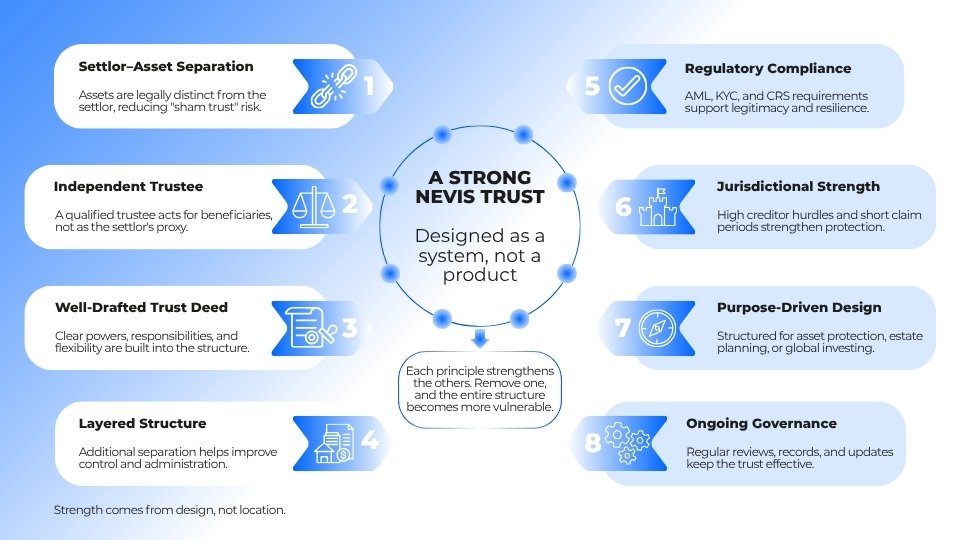
While privacy is appealing, do not confuse it with secrecy. Service providers and trustees operating under Nevis law remain obligated to follow anti-money laundering (AML) and know your client (KYC) regulations, among others.
Tax Neutrality and Planning Opportunities
A common misconception is that offshore trusts automatically eliminate tax obligations.
A Nevis trust may offer tax-neutral treatment within Nevis for certain non-resident structures; however, taxation generally depends on the tax residency of the settlor and beneficiaries, as well as the nature of the assets involved.
Depending on the individual’s circumstances, reporting obligations may apply.
Examples include:
- U.S. persons may need to report certain foreign trust interests under IRS or FATCA forms and rules
- UK residents may need to consider HMRC rules relating to offshore trusts
- Other countries may apply their own controlled foreign entity, inheritance, or wealth reporting rules
Therefore, a Nevis trust should be viewed as an asset-protection and wealth-planning structure rather than a method of avoiding tax.
Estate Planning and Multi-Generational Wealth Management
Many people who consider using Nevis trusts do so for creditor protection; however, there is another important benefit: multi-generational succession planning.
A trust allows families to create rules on how to manage and distribute their wealth over time. The options for managing family wealth include:
- Protecting your investments for the next generation (the money remains available but cannot be accessed until you say so)
- Making distributions to your beneficiaries under strict controls
- Protection from poor financial decisions by the beneficiary
- Continuing the family business/wealth when the original creator has passed away or is no longer able to run the business.
A trust provides families with continued control over the assets left behind and will provide flexibility to make changes as circumstances change for years to come.
Nevis Trust Structure: The Optimal Framework
A Nevis trust creates a separation of ownership and entitlement. When the settlor transfers the assets into the trust, they cease being the settlor’s own personal property; this adds one more layer of protection from potential claimants. At the inception of the trust, there are three key players that have defined responsibilities: the settlor, the trustee, and the beneficiary.
The Trustee manages the trust's assets as directed by the trust agreement (trust deed) and as a fiduciary. Nevis law specifies how the trust's assets will be treated. In essence, a Nevis trust provides flexibility and protection for the settlor, allowing him to use and benefit from his assets over time with minimal administration.
Key Roles: Settlor, Trustee, Beneficiary, and Protector
To thoroughly comprehend the nature of a Nevis trust, it will be necessary to evaluate the roles of each individual involved to determine how well they divide power and responsibility among themselves. The function of each individual role is unique and provides an essential legal and/or strategic basis for maintaining balance among control, asset protection, and overall offshore wealth planning over extended periods.
Settlor
A settlor (also referred to as a grantor) is the person(s) who creates a trust through the transfer of their assets to the newly created legal entity.
Generally speaking, settlors will:
- Decide on why a trust should be established,
- Choose who shall receive the benefits of the trust (the beneficiaries).
- Create how the trust will operate via the terms outlined in the deed of settlement, and
- Transfer ownership of the assets to the trust.
Upon completion of this action, a settlor no longer owns the assets. Instead, they are now owned by the trust and will be administered in accordance with the terms outlined in the trust documents.
Trustee
As the administrator of the trust, trustees have the obligation to manage and care for all aspects of the trust and, specifically, manage the trust's assets. As such, they also have a fiduciary duty to act consistently with both the terms of the deed of settlement and applicable law.
In general, some of the duties that a trustee typically has include:
- Administer the trust's property,
- Carry out actions in the best interests of the beneficiaries,
- Keep accurate records.
- Ensure compliance with all statutory requirements,
- Make investments or distribute funds as permitted by the trust documents.
Due to their neutrality, technical knowledge, and ability to provide continuity in administration, it is quite common for professional trustees to be named as administrators of trusts.
Beneficiaries
Beneficiaries are those individuals or entities who are entitled to benefit from the terms of the trust. These may be family members, future generations, charitable organizations, or other persons/entities who are specified in the trust documents.
The terms of the deed of settlement determine the following:
- Who can benefit from the trust
- When distributions can take place
- What restrictions exist.
This gives families the opportunity to adjust their wealth management strategy as circumstances change over time.
Protector (optional but common)
Optional but frequently utilized in Nevis trusts is a "protector." The protector is designed primarily as an additional layer of oversight over the operation of a Nevis trust. There are several circumstances where a protector would be beneficial, including:
- Monitoring trustee decisions to ensure they align with the intent of the settlor as originally stated
- Approving key actions taken by the trustee (e.g., large distributions, changes in investment strategy, replacement of a trustee)
- Providing an independent review process throughout the overall governance structure
Typically, a protector does not participate in ongoing administration; however, with the fiduciary duties assigned to a trustee and the well-defined roles within a Nevis trust structure, an independent reviewer can help ensure continued success while protecting beneficiaries' interests over time.
Combining with Nevis LLCs for Enhanced Protection
Many clients do not rely solely on a trust for their financial security; instead, they pair a Nevis trust with a Nevis LLC to provide an additional level of offshore asset protection and wealth preservation. There is very little required to create such a structure; the typical arrangement is that the trust will own the LLC and the LLC will hold all of the client's investment assets or operate the client's business. The creation of separate entities to own and manage assets makes the administration of both entities much simpler than if they were owned by a single entity (the trust). Additionally, separating the legal owner from the person operating the business or investment creates a greater distance between those who have control over the assets and the individuals behind them.
While the primary purpose of the trust is to protect and plan for long-term estate issues, the primary function of the LLC is to conduct daily business activities and/or to directly own and manage various investments. One of the most common uses of a trust-and-LLC combination is to separate ownership and management responsibilities. By establishing clear lines of authority regarding each responsibility, it may be possible to limit liability associated with both the ownership and operation aspects of your financial structure, thereby providing you with more flexibility in terms of how you wish to operate your business.
When there is only one member of the LLC, it is common for the trustee to serve as manager or to appoint someone to perform managerial duties. A Nevis trust vs. LLC combination provides an additional layer to the client's asset protection strategy without adding undue administrative complexity.
Establishing a Nevis Trust: The Proven Approach
Setting up an offshore company or a Nevis trust requires some work and professional assistance. Some of the major milestones are:
- Consultation and strategic planning
- Creation of custom-designed trust documents
- Preparation of necessary documentation
- Establishment/registration and formation
- Transfer of assets to the new trust structure
A lawyer or other professional advisor reviews that all aspects meet the requirements set forth by Nevis law and those of the client's home jurisdiction.
Step-by-Step Formation Process
The formation of a Nevis trust follows a structured format and provides guidance to attorneys and clients on compliance with the laws and rules of the state of Nevis, as well as information to help the client create a plan that includes the client's overall objectives for asset protection and estate planning. Each case is different; however, there is generally a consistent order to the steps taken in forming a Nevis trust.
- Client discussion with a lawyer or advisor (approx. 1 – 3 days). This is typically the first meeting. Here, the client discusses their objectives, describes the type(s) of property to be placed in the trust, and identifies any special issues they want addressed. In essence, the goal here is simply to determine if a Nevis trust will meet your needs and, if so, which style of structure will suit you best.
- Engagement of registered agent and local administrative service provider (approximately 2 – 5 days). Once direction has been given, a licensed registered agent will be engaged. The registered agent will oversee all local obligations, prepare the necessary documentation, manage any needed compliance actions required by applicable government agencies, and assist in completing all other matters required for progress.
- Determination and preparation of trust document pursuant to NIETO requirements (approximately 5 – 10 days). At this time, the trust document is drafted. At this stage, how the trust will operate, who will benefit from it, and how decisions will be made are all in accordance with the provisions of the Nevis International Exempt Trust Ordinance.
- Selection of trustee and optional protector (typically 3 – 7 days, dependent upon background investigations). Choosing a qualified trustee is vital. Many use professional trustees. Due diligence and compliance audits are conducted during this phase to ensure all applicable regulatory standards have been met.
- Submission to Registrar (Generally 1 – 3 working days). Upon completion of the documentation, all papers will be filed for registration in Nevis. Upon successful filing, the trust progresses toward its conclusion.
- Certificate of Registration (Usually issued shortly after approval). Upon completion of filing with the Registrar, a Certificate of Registration will be issued confirming the creation of a legally recognized trust.
- Transferring assets to the trust (varies widely from one week to four weeks, depending on the nature of the assets): Assets such as bank accounts, stock ownership in companies, interests in properties, etc., are formally transferred into the new trust to complete the formation.
While time frames may vary depending on the level of complexity, the amount of compliance required, and/or the type of assets included, most Nevis trusts take approximately three to six weeks to establish when properly managed.
Required Documentation and Registration
Setting up an offshore asset protection trust in Nevis typically involves preparing several standard documents and completing routine compliance checks before registering it. Each trust setup may have slightly different documentation requirements depending on what type of structure is being set up; however, generally speaking, most will require:
- The trust deed (the primary document outlining how the trust operates)
- Documentation showing the identity of and conducting due diligence on beneficial owners
- Compliance documentation with respect to Anti-Money
- Laundering/counter-financing terrorism
- Trustee appointment agreements
From an operational standpoint, this process should be relatively simple:
- Prepare the trust document
- Conduct a compliance review
- Submit all required documentation to the registrar
- Wait until you receive confirmation from the registrar that the trust has been registered.
There is nothing complicated about this process; however, preparing all necessary documents correctly at the outset will help eliminate future complications and ensure proper recognition of the trust.
Nevis Trust Cost Analysis: Typical Investment Requirements
Costs for setting up and managing a Nevis trust will depend on the number of parties involved, the type and value of the assets placed into the trust, and the professional advisers engaged to help create and manage it. Examples of factors that could increase the cost of an offshore Nevis trusts include bespoke drafting, multiple jurisdictions, and an interest in using other types of entities (e.g., a Nevis Limited Liability Company), all of which may require tax advice.
| Cost Category | Typical Range |
| Trust setup fees | $5,000–$15,000+ |
| Legal drafting | Included or separate depending on provider |
| Registration fee | Government charge payable upon formation |
| Trustee fees | Annual service cost based on responsibilities and asset value |
| Annual maintenance | $2,000–$6,000+ |
The costs of creating an offshore trust typically include initial setup costs, such as meeting with the client to discuss how their trust should be structured, preparing the trust deed, conducting compliance checks, and coordinating the trust's registration. The costs of legal drafting may be included in an advisory package or billed separately, depending on whether any customization is needed.
Is a Nevis Trust Worth It? Key Considerations
Depending on your personal situation and goals, a Nevis trust may be appropriate, but only if it meets your needs. Individuals may consider a Nevis trust if they seek additional protection against litigation, creditors, or other claims to their assets, or as part of a long-term plan to create a legacy for family members or to manage international operations or investments.
Some considerations that may be helpful in deciding whether a Nevis trust is suitable for your specific needs would include:
- Do you have concerns about exposure to various legal issues (e.g., civil judgments) or creditor risk?
- Do you own property in foreign countries or do business internationally?
- Is the confidentiality of your financial affairs important to you?
- Are you engaged in succession planning for your estate and/or seeking to preserve the wealth of your family for multiple generations?
If so, then a Nevis trust could serve as one component of an overall family wealth planning strategy; however, it will likely only appeal to those whose primary objective is to increase the level of protection afforded by law regarding the transfer of their assets and who are willing to take a longer view when structuring their plans.
