
Asset protection is typically at the center of discussions around Nevis trusts, but while the jurisdiction is an important factor as to why a Nevis trust is effective, its design, management, and use are equally or even more important than where you establish it.
The combination of legally separating your assets, having a thoughtfully structured trust, and maintaining ongoing compliance will provide you with a vehicle to hold and protect your assets over time and across geographic boundaries.
Key Takeaways
- Strong Nevis trusts are determined by their own design rather than the laws of that country
- Individuals and assets must be clearly separated to create a robust trust
- The trustee’s ability to act independently provides much of the power behind a strong trust
- Adding a company (such as an LLC) to your trust will likely provide greater asset protection
- Compliance with Anti-Money Laundering (AML), Know Your Customer (KYC) and Common Reporting Standard (CRS) is mandatory and unavoidable.
- A poorly designed trust, or one where you have too much control, may significantly reduce its overall effectiveness.
- Just as creating a trust is necessary, so is its ongoing management.
Nevis Trust FAQ: Quick Answers
Before exploring the principles that contribute to a strong Nevis trust, here are answers to some of the questions people most commonly ask.
What actually makes a Nevis trust “strong”?
A Nevis trust can be effective, but it depends on many factors. A number of these factors include proper drafting of a trust document (trust deed), good separation from the owner (settlor) of the trust assets, an independent trustee, appropriate administrative controls, continued compliance with the trustee, relevant regulatory obligations, and professional administration.
Can a Nevis trust really protect assets?
Assets protected within a trust structure do pose significant obstacles to creditors. When you take advantage of the legal separation of property rights provided through trusts and combine this with one of the most widely recognized asset protection regimes available, your ability to prevent creditor access to your assets increases. But no trust regime offers complete protection. Each situation depends on the particular facts involved, the governing law, and how the structure is operated.
Why is Nevis considered a leading trust jurisdiction?
The reasons for Nevis’ success as a respected offshore trust jurisdiction include a modern trust law system; creditor-friendly procedural rules and processes; a highly qualified and experienced trust services industry; and a body of laws designed to enable and facilitate international estate planning and asset protection.
What is a Trust Protector?
A trust protector is typically someone chosen by the settlor to serve as an independent overseer of the trustee(s)’ decision-making process. In addition to acting independently of the trustee(s), the trust protector also acts independently of both the beneficiaries and the settlor. Under the terms of the trust agreement, the trust protector may have the authority to approve trustee actions, such as replacing a trustee, approving large distributions from the trust fund, approving changes to the trust’s terms, and ensuring the trust continues to meet the settlor’s needs and objectives. The appointment of a trust protector is optional; however, it is relatively common in more sophisticated international trust arrangements.
Can a Nevis trust own an LLC or other companies?
Yes. There are many ways in which international wealth structures use combinations of trusts (such as a Nevis trust) and companies (such as a Nevis limited liability company) to achieve their goals. For example, an underlying company may be owned by a trust, which in turn may hold shares in several other entities. Such a structure can help simplify administrative functions, clarify ownership interests, and provide greater legal separation between the settlor and the ultimate beneficial owners of the underlying assets.
What Makes a Nevis Trust “Strong”?
No trust is inherently “strong” simply by being established in Nevis.
Although Nevis provides a positive legal climate for establishing trusts (and specifically asset protection), this does not guarantee success. The strength of a trust will depend on how the trust was created, how roles were assigned, and whether all aspects can withstand legal and practical scrutiny.
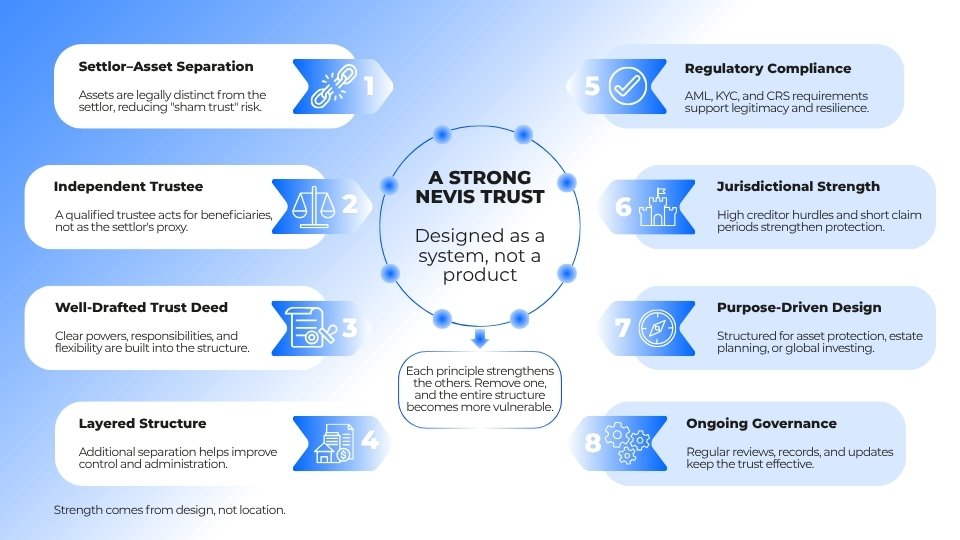
Ultimately, think of a trust more as a system than a product. Ultimately, how successfully the system functions depends entirely on how well it was designed.
The 10 Core Principles of a Strong Nevis Trust Structure
After moving beyond a basic understanding of trusts, you come to realize that creating a successful trust depends on more than one factor. A successful trust comprises multiple factors and the way these components interact. If one element is missing or performs poorly, the entire structure may become unstable.
Each of the eight key principles plays a distinct role and works together to create a complete structure. If one principle is weak or absent, the structure may become unstable.
1. Clear Separation Between Settlor and Assets
One of the most important principles underlying trust law is the legal segregation of trust assets from both the settlor and other parties. As such, once an asset has been properly transferred into a trust, legal title vests in the trustee for the benefit of the beneficiaries under the trust deed. In addition, courts may disallow or disregard arrangements if they determine that the settlor retains too much control over the trust’s assets, which may be characterized as a ‘sham trust’ at common law.
To achieve this goal, there are some key items to accomplish:
- The transfer of the assets has to occur. Just listing them on paper is not enough.
- You cannot treat the property as if it remains under your full control.
- Do not use the trust as an extension of your personal banking operation.
When you blur the line separating yourself from the assets, you reduce the credibility of the overall structure. In extreme cases, you can jeopardize the existence of the trust itself, which is known as a sham trust. As soon as you’ve reached the level of having a sham trust, the structure collapses very quickly.
2. Independent and Competent Trustee
The trustee serves as a primary agent of the trust. Their responsibility includes administering the trust in a manner consistent with its terms. Their independence is critical to the structural integrity of the trust.
A common scenario for a successful establishment would include:
- An independent professional trustee
- Clear decision-making responsibilities
- A balanced approach to oversight and flexibility
If the trustee acts solely as a proxy for the settlor and controls all actions related to the trust, the structure loses all value. Independence is a necessity to ensure that the trust maintains credibility.
3. Properly Drafted Trust Deed
The way a trust operates is defined in the trust deed. The trust instrument identifies all parties who will be beneficiaries of the trust and outlines the limits of authority contained within the trust structure.
A well-defined trust instrument includes:
- Clearly outlining the specific goals that the settlor had when creating the trust instrument
- Allowing for flexibility in order to make possible changes to the terms of the trust at some point in time
- Clearly defining the roles, powers, and limitations of each party involved in the administration of the trust
Generic templates are available for drafting trust documents. Generic templates have utility (i.e., ease) in certain situations; however, using generic templates may offer little advantage over creating your own customized template for structuring international assets and/or implementing asset protection strategies.
4. Layered Structure (Trust + Company)
When you are using a Nevis Trust in conjunction with an underlying company — usually a Nevis LLC or some form of offshore entity — the typical structure would be:
Trust → Company → Assets
With each additional layer of separation created by added complexity, rather than having the trust hold assets outright, the trust will own a company responsible for asset management.
Why does this matter?
| Layer | Role | Benefit |
| Trust | Holds ownership | Creates legal separation |
| Company | Holds assets | Simplifies operations |
| Assets | Investments, property, etc. | Structured ownership |
As such, this model can help manage numerous assets in various countries around the globe, both to keep them organized and to maintain the confidentiality of your wealth.
5. Compliance with International Regulations
Offshore structures are often thought to be beyond regulation. For a modern trust to exist, it must adhere to all international standards. A Nevis Trust must comply with all international standards related to Anti-Money Laundering (AML), Know Your Customer (KYC), and the CRS (Common Reporting Standard). Offshore trusts now operate in an increasingly transparent environment, including the OECD CRS and the FATF Money Laundering Recommendations.
These recommendations require financial institutions to collect and share beneficial ownership data across jurisdictions. Therefore, for an entity to remain compliant, it must document who benefits from owning the trust assets, as well as how its financial institution collects and shares this information about the trust. Regardless of whether or not you live in the jurisdiction in question, reporting obligations will still apply. This is not to say that there is no right to privacy in this area, just that you have a right to structured privacy. If you ignore these rules, then you may create significant risk.
6. Jurisdictional Strength (Why Nevis)
Nevis is an attractive jurisdiction for both the legal treatment of claims made by creditors against trusts and for its unique legal system.
Positive elements of Nevis’ legal system concerning claims made by creditors against trusts are as follows:
- Nevis has one of the shortest limitation periods for creditor claims in relation to trusts.
- Prior to pursuing claims, creditors are required to post bonds.
- Claims against a trust must occur within the borders of Nevis.
In summary, while none of the above create full protection of the assets involved, they do offer more protection than in many other jurisdictions. To protect your assets via a trust, the trust itself must be properly formed.
7. Purpose-Driven Design
Not all trusts will have been created with the same purposes; therefore, the amount of emphasis placed on creating a proper purpose when creating a trust seems to be underappreciated.
For example, if you created a trust to:
- Protect assets
- Plan estates
- Form businesses
- Invest across international boundaries
The design would most likely differ depending upon what was initially intended.
Using a single “template” or “blanket approach” when developing a particular type of trust could create inefficiencies and/or gaps. A well-designed Nevis trust clearly identifies the initial intention at inception
8. Ongoing Management and Governance
Ongoing management and governance are just as important as establishing a trust. In fact, most established trusts evaluate themselves periodically to ensure they continue to serve their intended purpose. They also maintain accurate records and consistently monitor compliance with the terms of the trust agreement. Many issues associated with poorly created or underperforming trusts can be attributed to a lack of attention in later years rather than a lack of vision during initial formation.
9. The Role of a Trust Protector
In many cases, the creators of a sophisticated Nevis trust will also choose to name a trust protector. While a trust protector is not responsible for managing the day-to-day activities of the trust (i.e., the administration of the trust), he/she/it provides overall strategic direction and management for the trust. In some jurisdictions, a trust protector has limited but significant powers, which include, for example, approval of new trustee(s); removal or replacement of existing trustee(s); and/or consent to large discretionary distributions from the trust or, conversely, the ability to prevent certain specified action(s).
While it is not required, having a competent and experienced trust protector can enhance the governance structure of the trust by providing an additional level of checks and balances in long-term family wealth planning or more complex international estate planning situations.
10. Flexibility to Adapt Over Time
The strength of a good trust lies within its flexibility. Over time, family conditions, tax laws, residency status, investment options, and succession plans can all change. A properly drafted A Nevis trust contains provisions that enable trustees and, if applicable, the trust protector to address changes in circumstance while maintaining consistency with the settlor’s initial intent.
How These Principles Work Together
Taking a look at each element separately is interesting; however, it is much more effective to see how the elements come into play within a real-world scenario.
For example, an international businessman who has made investments in several countries may have other types of property (physical or intellectual), etc. If he were to hold all of his interests personally, tracking them would be very difficult and burdensome from both management and legal standpoints. Therefore, he establishes a structure to house and protect his global interests.
At the top level of this structure resides a Nevis trust. This trust owns a company, which in turn holds all of the assets. In essence, this structure looks similar to the following:
- Nevis trust at the top
- Company owned by the trust
- Company holds assets
This creates a distinct separation between the individual and the assets he holds. This separation provides a vehicle to effectively manage your global assets in one place, particularly when dealing with multiple jurisdictions, and a solid framework for establishing long-term plans.
As previously stated, none of these concepts stands alone. They all interrelate. The separation between the individual and their assets, the role of the trustee, the establishment of the structure, and the regulatory compliance requirements collectively provide a cohesive picture. When properly established, what appears complex is merely the process of establishing a structure that will endure.
Legal framework
Nevis trusts operate under the applicable statutory trust law, governed by the Nevis International Exempt Trust Ordinance and regulated by the Nevis Financial Services Regulatory Commission. The ordinance provides a basis for defining the rights, obligations, and responsibilities of trustees; the processes by which creditors may seek redress against assets protected by an exempt trust; and the legal framework governing the operation of asset protection provisions in an exempt trust.
Common Mistakes That Weaken a Nevis Trust
Many times, even with good intentions, there are always areas where things fall apart when setting up an estate plan. Frequently, it is the little “oversight” that causes future headaches.
The following are some of the most common traps into which individuals may fall:
- Holding too much control over assets within the trust: If the grantor(s) continue to have complete control over the assets and/or continue to view the trust as their own, this will cause confusion about the trust’s separate identity and the grantor(s).
- Selecting an incompetent or ineffective trustee: An inept or inactive trustee can undermine the effectiveness of the overall estate-planning strategy. The trustee must take his/her responsibilities seriously and not simply fill the position for form’s sake.
- Building in excessive complexity: While adding additional layers may appear to add greater protection, they frequently result in increased costs and administrative burdens without significantly added benefits.
- Failure to comply with reporting obligations: Failure to file required reports (even inadvertently) creates potential liability for both civil and criminal sanctions and/or tax penalties.
- Poor record-keeping: Poor documentation will eventually make it difficult to establish or defend the administration of the trust. Good documentation is important; it truly makes a difference.
When a Nevis Trust Structure Makes the Most Sense
A Nevis Trust tends to make sense once the complexity begins to grow, especially as you cross into other countries.
These are common examples:
- Managing assets in multiple countries
- Building a structure that will allow your wealth to endure over time
- Creating an asset protection plan with a defined legal framework
- Combining various investment options
At this point, the combination of both flexibility and structure is very beneficial.
When It Might Not Be Necessary
There are also times when a Nevis trust does not make sense for you.
- If you have assets only located in one country
- If your overall structure is straightforward
- If the compliance burdens are greater than the potential benefits of using a Nevis Trust
- If there is a less complicated way to accomplish what you want to do legally
You do not need to use an offshore layered structure all the time. Forcing it can add unnecessary complexity.
Summary
Setting up a Nevis trust alone is insufficient to build a solid one. The strength of a Nevis trust can develop over time, depending on how effectively it is set up and managed. As such, when structured and operated appropriately and compliantly, a Nevis trust can provide significant benefits in protecting assets placed into the trust. An investment manager or a person planning for the future who needs cross-border protection should consider establishing a Nevis Trust. However, like all asset protection tools, the ultimate success of the tool depends on how effectively it was initially built and put into use.
Frequently Asked Questions
What actually makes a Nevis trust “strong”?
There are several reasons why a Nevis trust is referred to as “strong.” These include the way in which the trust was originally formed. Forming a strong Nevis Trust involves first creating a trust in a foreign country (such as Nevis). Secondly, separating your interest in the assets from the assets themselves. Thirdly, selecting an independent trustee to serve as fiduciary for the beneficiaries. Fourthly, drafting a clear and enforceable trust agreement. Fifthly, maintaining compliance throughout the trust’s existence. If each element is properly included in forming a new trust, then, generally speaking, the new trust will continue to function as long as one or more of those original elements continue to function.
How does a Nevis trust protect assets in practice?
In practical terms, a Nevis trust separates your property from yourself. Instead of owning the property outright yourself, the property is instead held by a separate entity (the trust itself), which provides additional layers of protection against claims made by creditors and other interested third parties. This does not mean that the assets cannot be reached by any individual, but it certainly makes it much more difficult for them to do so.
Is using a Nevis trust actually legal?
Yes, provided that they are created and used in accordance with applicable law in the jurisdictions in which they exist. Inasmuch as they constitute a form of formally recognized estate-planning entity under applicable law, Nevis Trusts are subject to the rules and regulations of regulatory bodies, including anti-money laundering (“AML”), know your customer (“KYC”), and common reporting standards (“CRS”). Thus, while they may offer some advantages, they are nonetheless subject to laws governing operation in every jurisdiction in which they operate.
Can a Nevis trust be challenged?
While a Nevis trust can indeed be contested, challenges to a Nevis trust are typically difficult due to the fact that laws of Nevis impose considerable obstacles for plaintiffs attempting to challenge the validity of a properly drafted and organized trust. Although this does not preclude the possibility of a contest arising, it does suggest that any plaintiff wishing to successfully challenge a Nevis trust must overcome greater barriers than might be encountered with most alternative structures.
Do Nevis trusts make you anonymous?
No. To imply that a Nevis trust offers you “anonymity” is misleading. A Nevis trust does provide you with privacy (primarily because there are no public records related to your interest in the trust) — but “anonymity” means total concealment. Concealment of this nature is impossible since ownership information is maintained somewhere and can be accessed by competent authority if necessary.
