When your finances start to stretch across borders, things can get messy surprisingly fast. What works in one country doesn’t always translate neatly into another, and suddenly you’re dealing with different rules, risks, and long-term questions about how everything fits together.
That’s usually the point where people begin looking at more structured solution - and Nevis trusts often come up in that conversation. Not because they’re complicated for the sake of it, but because they offer a way to organise assets more clearly, create some distance between you and what you own, and plan ahead with a bit more confidence. In this article, we’ll walk through how Nevis trusts work, where they tend to make sense, and what you should keep in mind before setting one up.

Key Takeaways
- Nevis trusts are widely used for asset protection and private wealth planning
- They create legal separation between individuals and their assets
- Strong local laws make it more difficult for creditors to challenge structures
- Often combined with offshore companies to create layered ownership
- Must comply with international standards like AML, KYC, and CRS
- Best suited for cross-border wealth, complex portfolios, and long-term planning
What Is a Nevis Trust?
At its core, a Nevis trust is a legal arrangement where one party (the settlor) transfers assets to another party (the trustee) to manage on behalf of beneficiaries.
What makes this structure different from simply owning assets directly is that the trust (not the individual), becomes the legal owner. This creates a clear separation between personal identity and the assets themselves.
A typical setup involves three key roles:
- Settlor – the person who creates the trust and contributes assets
- Trustee – the entity responsible for managing those assets
- Beneficiaries – the individuals or entities who benefit from the trust
In practice, a Nevis trust can hold a wide range of assets, including:
- Shares in offshore companies
- Real estate (directly or indirectly)
- Investment portfolios
- Digital assets or business interests
For example, instead of holding investments in your own name, you might place them into a trust, which then owns a company that manages those assets. It sounds layered, but that structure is exactly what creates flexibility and protection.
Why Nevis Trusts Are Used in Private Wealth Planning
People don’t usually set up a Nevis trust just for the sake of it. It tends to make sense in situations where things are already a bit more complex: multiple jurisdictions, higher-value assets, or long-term planning needs.
Asset Protection
One of the main reasons Nevis trusts are used is asset protection.
Nevis has developed a legal framework that makes it more challenging for external parties to bring claims against assets held in a trust. This doesn’t make assets untouchable, but it does create additional legal hurdles.
In practical terms:
- Claims often need to be brought within Nevis courts
- The burden of proof is higher than in many jurisdictions
- Certain legal protections apply to properly structured trusts
For individuals exposed to business risks or operating internationally, this added layer can be significant.
Privacy and Structured Ownership
Privacy is another key factor, but it’s often misunderstood.
A Nevis trust doesn’t “hide” assets. Instead, it controls how ownership information is accessed. Trust details are generally not publicly listed, and ownership is structured in a way that separates individuals from direct asset ownership.
This can be useful if:
- You manage assets across multiple countries
- You prefer to keep ownership details out of public records
- You want a clearer distinction between personal and business holdings
Estate and Succession Planning
Trusts are also widely used for long-term planning.
Because the trust already owns the assets, transferring wealth to the next generation can be more straightforward. There’s no need to reassign ownership in the same way you would with personally held assets.
This can help:
- Avoid probate in certain jurisdictions
- Reduce delays in inheritance processes
- Provide continuity in asset management
Cross-Border Wealth Structuring
If your assets or income span multiple countries, things can get complicated quickly.
A Nevis trust can act as a central structure that holds and manages those assets in one place. Instead of dealing with multiple ownership arrangements, everything sits within a single, organised framework.
What Makes Nevis Trusts Different?
Not all offshore trusts are built the same, and Nevis tends to stand out for a few practical reasons. Over time, it’s developed a legal framework that’s specifically geared towards asset protection and flexible structuring, which is why it comes up so often in this space.
A few things that set it apart:
- There are relatively short time limits for bringing claims against trusts, which can reduce long-term exposure.
- Creditors are usually required to post a financial bond before they can even begin legal action, which can discourage weaker claims.
- The laws include safeguards around so-called “fraudulent transfers,” provided the structure has been set up properly.
- The overall legislation is quite flexible, so trusts can be tailored to fit different situations rather than forced into a rigid format.
Taken together, these features are a big part of why Nevis is often mentioned when people talk about offshore asset protection and long-term wealth structuring.
How a Nevis Trust Structure Works in Practice
In most cases, a trust doesn’t operate in isolation. It’s often combined with a company to create a layered structure.
A simplified version looks like this:
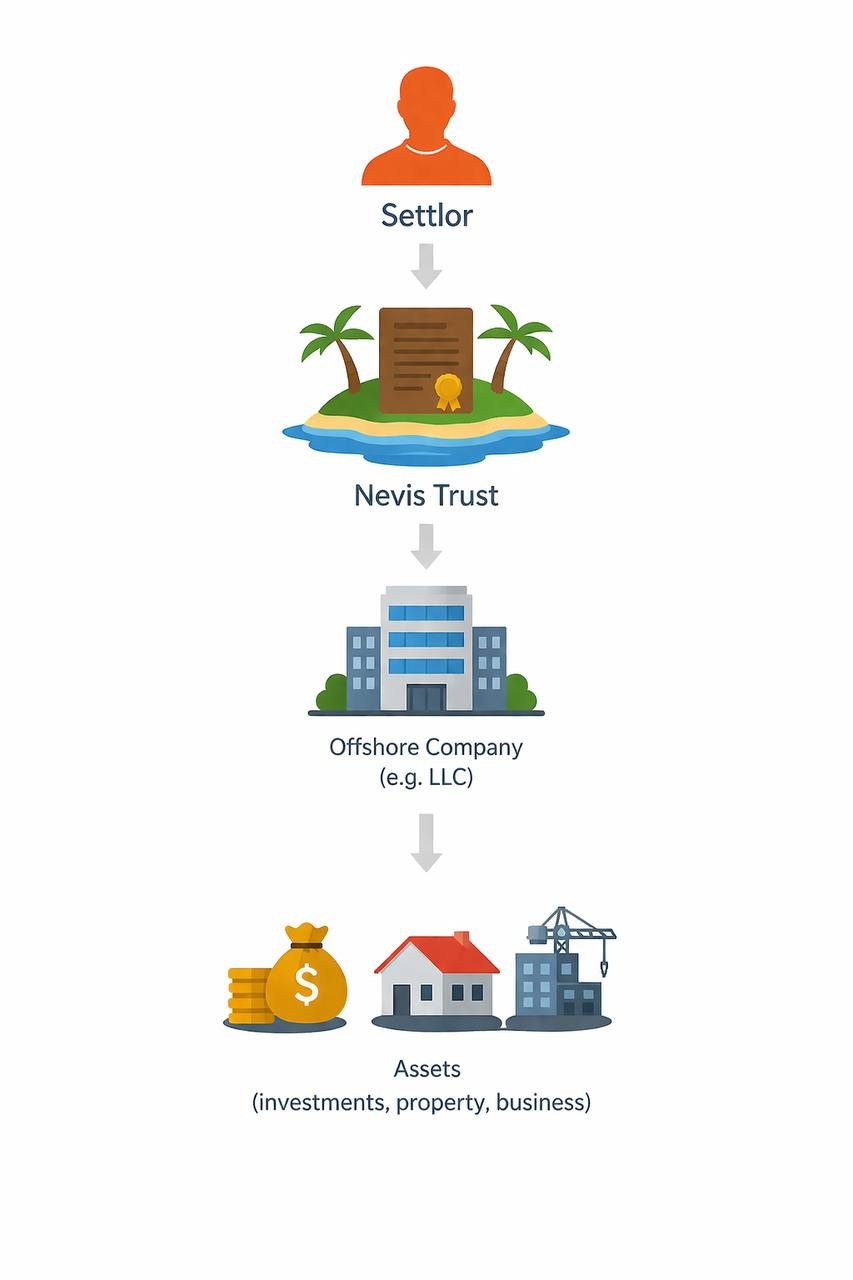
Here’s how it works:
- The trust becomes the legal owner of the company
- The company holds and manages the assets
- The individual is no longer directly linked to those assets
Example Scenario
Imagine an entrepreneur with investments in different countries and a business operating internationally. Instead of holding everything personally, they set up a Nevis trust. That trust owns a company, which in turn holds the assets.
This setup:
- Separates personal identity from assets
- Simplifies contracts and ownership structures
- Adds a layer of legal protection
When to Use a Nevis Trust
Nevis trusts tend to make sense in situations where there’s a need for structure, protection, or long-term planning.
Common use cases include:
- Managing international investment portfolios
- Structuring ownership for business founders
- Planning wealth transfer across generations
- Holding assets in multiple jurisdictions
- Combining different asset types under one structure
In these cases, the trust acts as a central “holding layer” that brings everything together.
When a Nevis Trust Might Not Be Necessary
This is often overlooked, but important.
A Nevis trust isn’t always the right solution. In simpler situations, it may add unnecessary complexity.
For example:
- If you only hold assets in one country
- If your portfolio is relatively small
- If a simpler company structure would achieve the same goal
In these cases, the cost and administration may outweigh the benefits.
Costs and Practical Considerations
Setting up and maintaining a Nevis trust involves both initial and ongoing costs.
Typical Cost Overview
| Cost Type | Approximate Range | Notes |
| Trust Setup | $3,000 – $10,000+ | Depends on complexity |
| Annual Trustee Fees | $1,000 – $5,000 | Varies by provider |
| Legal Support | $1,000+ | Structuring and updates |
| Compliance & Reporting | Varies | Depends on assets |
Beyond costs, there are also practical aspects to consider:
- Choosing a reliable trustee
- Maintaining proper documentation
- Ensuring compliance in all relevant jurisdictions
The structure itself isn’t complicated, but getting it right at the start matters.
Risks and Common Mistakes
Like any legal structure, Nevis trusts need to be handled carefully.
Some common pitfalls include:
- Non-compliance with home country tax rules
- Overcomplicating the structure with unnecessary layers
- Misunderstanding privacy as complete anonymity
- Poor planning, leading to gaps in control or governance
In many cases, simpler and well-thought-out structures work better than overly complex ones.
Nevis Trust vs Other Jurisdictions
Here’s a quick comparison of how Nevis fits alongside other trust jurisdictions:
| Jurisdiction | Key Strength | Best Use Case |
| Nevis | Asset protection | Cross-border wealth |
| Cayman Islands | Reputation | Institutional structures |
| Jersey | Stability | European clients |
| Belize | Simplicity | Smaller trusts |
Nevis tends to stand out when asset protection is a priority, rather than just ease of setup.
Legal and Compliance Considerations
A common misconception is that offshore trusts operate outside regulation. In reality, they are part of a structured and compliant system.
Nevis trusts must align with international standards, including:
- AML (Anti-Money Laundering)
- KYC (Know Your Customer)
- CRS (Common Reporting Standard)
This means:
- Financial institutions collect ownership information
- Authorities can access data when legally required
- Reporting obligations still apply
Privacy exists, but within a regulated framework.
How to Set Up a Nevis Trust
Even though this is usually handled with professional support, the overall process isn’t as complicated as it might seem. At a high level, it tends to follow a few clear steps:
- Start by defining your goals: whether that’s asset protection, estate planning, or simply organizing wealth across different countries. This part matters more than people expect, because it shapes everything that follows.
- Choose a trustee: this is the person or entity responsible for managing the trust, so it’s important to pick someone reliable and experienced.
- Draft the trust deed: essentially the rulebook of the trust, outlining how it works, who benefits, and how decisions are made.
- Transfer assets into the trust: this is the step where the structure becomes “active,” as ownership is formally moved under the trust.
- Make sure everything is compliant: not just in Nevis, but also in any country connected to you or your assets.
The setup itself is often quick - the real work lies in designing the right structure.
Summary
Nevis trusts are commonly used in private wealth planning because they provide a way to organise assets, add a layer of protection, and plan for the long term. They’re especially useful in cross-border situations where ownership, legal exposure, and succession can become more complex.
That said, they’re not a one-size-fits-all solution. They come with costs, responsibilities, and the need for proper structuring. When used thoughtfully, though, they can be a practical tool for managing wealth in a more structured and resilient way.
