In many cases, once someone begins exploring offshore structures, they typically ask themselves, "Where am I likely to be able to achieve some degree of privacy while still operating within the law?" It is not always easy to determine which jurisdiction(s) may offer adequate privacy, as each operates somewhat differently.
What constitutes "privacy" today is far removed from how it was viewed only about a decade ago. Certain jurisdictions have developed reputations for being more accommodating in providing greater discretion and flexibility in recording the beneficial owners of property and holding other assets. Many times, these jurisdictions are selected by individuals who manage their global investment portfolios or are establishing long-term wealth structures (as a means of creating clarity regarding ownership), where having a degree of separation and understanding of ownership can greatly impact the success of such endeavors.
The following report compares many of the world's top offshore financial centers by their laws regarding privacy, corporate confidentiality, trust structures, and asset protection frameworks. It has been prepared to assist private clients interested in establishing an international structure or a foreign company as part of an overall strategy to protect their assets through trusts.
Key Takeaways
- Nevis, Belize, Seychelles, Panama, and the British Virgin Islands (BVI) are probably the five most popular offshore privacy jurisdictions.
- All of these have confidentiality in their company structure and asset protection laws.
- Often, a trust is paired with an offshore company to provide greater control and privacy.
- Privacy is not the same as secrecy. All offshore structures must be compliant with international regulations.
- The selection of the correct jurisdiction will depend upon what you want to accomplish, what type of assets you wish to protect, and your overall preference for the law.
What Makes an Offshore Jurisdiction “Private”?
When individuals speak of "offshore" privacy, they generally refer to the degree of publicly available information about ownership/asset(s) and to the extent an offshore jurisdiction protects this information through its legal system.
One point to clarify now, before we go further: While both concepts are related, "privacy" and "secrecy" are distinct. Most countries with reputations for having strong offshore jurisdictions have implemented very specific, strict international compliance regulations, including AML (Anti-Money Laundering) and KYC (Know Your Customer). As a result, there has been no free-for-all. In other words, these countries implement "controlled confidentiality," and while private financial information will exist, it will not be readily accessible by the general public.
In practical terms, many offshore company structures allow:
- Ownership information should not be published in public registers.
- Trust structures that create a separation between formal title/ownership and actual control over property/assets
- Financial data shall not be publicly disclosed for anyone's viewing
- Legal systems that are designed to prevent the claimants from accessing an individual's personal/business affairs unnecessarily
Therefore, what makes a jurisdiction "privacy-friendly"? Generally, this is achieved through a combination of legal and structural components, including:
- Beneficial ownership registers that are non-publicly accessible
- Strongly developed trust laws
- Flexible company structure types (i.e., Limited Liability Companies / International Business Corporations)
- Clearly defined asset protection mechanisms
- Predictable legal system
Why Offshore Trusts Play a Key Role in Privacy
In many cases, offshore privacy isn’t achieved through a company alone. Instead, it involves a multi-layered structure, often built around an offshore trust.
A simple example looks like this:
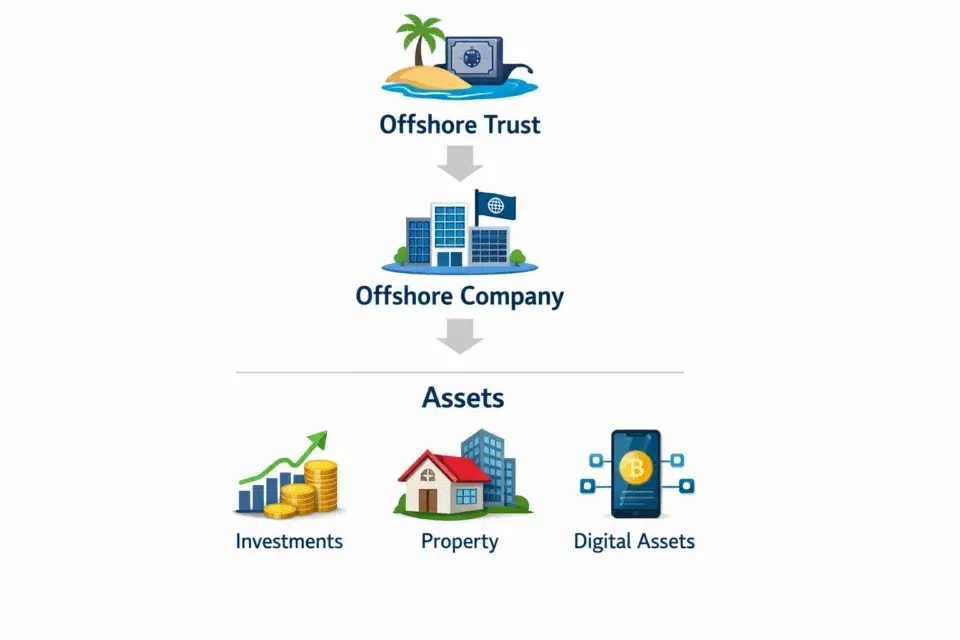
This structure creates legal separation between the individual and the assets.
Why Does This Matter?
- Trusts become the legal owners of companies.
- Companies hold assets.
- Individuals are no longer directly connected to these assets.
This arrangement may also allow for:
- Protection of assets
- Benefits of estate planning
- Ownership structured as desired
- Increased anonymity
Due to that reason, areas with trust-friendly laws generally have stronger privacy protections.
Top 5 Offshore Jurisdictions for Privacy
1. Nevis
Nevis is likely one of the most powerful jurisdictions for protecting your assets and maintaining privacy from the public. Nevis LLCs provide several key features that support this goal, as do offshore trusts and strong creditor protections.
One of the greatest advantages of using Nevis is that it is difficult for outsiders to challenge or dispute asset structures established within Nevis. The legislation governing Nevis, along with the flexibility in structuring options available, has given Nevis a very good reputation. The Nevis offshore trust structure is governed by the Nevis International Exempt Trust Ordinance (NIETO). NIETO provides statutory protection for trusts established in Nevis.
Common applications:
- Asset protection structures
- Wealth planning for families
- Holding companies for investments
When you use Nevis in combination with offshore trusts, you can create multiple layers of protection to enhance both privacy and control.
2. Belize
Belize is very well known as one of the easier jurisdictions in which to operate offshore companies. Belize’s International Business Company (IBC) offers the simplest way to establish an offshore company.
The IBC provides you with:
- Shareholders' anonymity
- Easy administration of your new company
- Global flexibility to do business anywhere in the world
Many people have chosen Belize for the combination of privacy and ease of doing business. Belize International Business Companies are regulated by the Belize International Business Companies Act, administered by the Belize Financial Services Commission.
Strengths include:
- Easiest and fastest formation of a company
- Corporate laws that protect your identity
- Lighter administrative burden compared to other jurisdictions
While Belize does not offer the same level of asset protection as Nevis, it can be another suitable option if you are seeking a corporate privacy structure.
3. Seychelles
Seychelles is considered an attractive location for International Business Companies (IBCs) and general international commercial activities.
It offers:
- An easy way to follow through on your incorporation process;
- Flexibility in the corporate law area;
- A private business climate;
To satisfy international regulatory requirements, Seychelles has had to amend its regulations several times since its inception; however, it still maintains a high level of shareholder anonymity.
Some common uses are:
- Trading companies;
- Holding companies;
- International / digital companies.
Many individuals choose Seychelles for its simplicity and ease of access, making it suitable for numerous small-scale offshore operations.
4. Panama
Panama has a reputation as one of the most developed and respected Offshore Financial Centers (OFCs) and an established history in international finance.
Unlike many other jurisdictions, Panama offers a wide variety of entities, including private interest foundations and offshore trusts, thereby providing a wider range of financial services than almost all other countries.
This makes Panama a good location for a variety of complex or large-scale offshore structures.
Advantages:
- A well-established legal system
- Large selection of financial services available
- More than one way to create your company
Due to these characteristics, Panama generally appeals to those looking for a combination of privacy, adaptability, and long-term stability.
5. British Virgin Islands (BVI)
The British Virgin Islands (BVI) are among the most popular jurisdictions utilized by foreign investors around the world for creating a corporate structure or international investment vehicle.
Advantages of utilizing the BVI include:
- A legal system that is well recognized on a global basis;
- Flexibility in terms of the law governing the creation and operation of corporate bodies;
- Compatibility with offshore trusts.
In comparison to its past, the BVI has greater regulatory transparency today, but it still remains a suitable environment for supporting the activities of international business.
Utilizations of the BVI include:
- Use as investment holding companies;
- Formation of joint ventures;
- Utilization as cross-border business entities.
The major advantage of the BVI is the credibility and acceptability it offers internationally, rather than maximum secrecy.
Comparison of Offshore Privacy Jurisdictions
| Jurisdiction | Privacy Level | Trust Strength | Best Use Case |
| Nevis | Very High | Very Strong | Asset protection |
| Belize | High | Moderate | Simple offshore companies |
| Seychelles | High | Moderate | International business |
| Panama | High | Strong | Complex structures |
| BVI | Moderate-High | Strong | Global investment |
Privacy vs Transparency: What You Need to Know
One of the largest misconceptions surrounding offshore jurisdictions is that they operate entirely outside of regulations.
Most offshore jurisdictions today adhere to the following regulations:
- CRS (Common Reporting Standards)
- FATF guidelines
- Anti-money laundering (“AML”) and anti-terrorist financing (ATF) regulations
As such:
- Financial institutions will continue to gather all applicable ownership information on accounts and/or investments;
- Authorities may obtain access to account/investment-related data upon receiving proper authorization;
- Applicable offshore structures must be appropriately disclosed.
So where does privacy come in?
At this point, people generally have their best understanding of offshore jurisdictions confused. Privacy, when referring to offshore structures, is not necessarily about avoiding regulations or evading detection; it's more about controlling who receives access to your data and who has visibility into the data collected.
Often times, while the actual data is still available, it is not accessible to everyone. For instance, you may find that ownership is not listed in publicly available registries. Data is usually distributed via formal channels, and only when there is a legitimate reason to do so. Additionally, how a person creates their offshore structure (specifically trust-based structures) can provide a clear separation between individuals and their associated assets.
To put it another way, it's not about concealing anything. Rather, it's about creating a structural environment within which privacy is developed in a controlled manner consistent with law, as opposed to providing complete visibility.
Example Offshore Privacy Structure
An international investor with assets located throughout the world may wish to establish an entity to manage such assets. An example of how he or she may accomplish this would be as follows:
- Establish a trust in Nevis (offshore)
- Trust establishes a Limited Liability Company ("LLC") in Nevis
- The LLC maintains investment(s) globally
Benefits of the above structure:
- Separates one's personal identity from their assets
- Provides legal protections
- Allows for structured governance
- Increases options for flexible long-term planning
How to Choose the Right Jurisdiction
There isn't a single "best" offshore jurisdiction — the most suitable one depends on your objectives. Below are several key factors to consider when choosing an appropriate offshore jurisdiction.
1. Type of Assets
An effective way to begin evaluating the available options is to identify the types of assets you are looking to manage. Managing a portfolio of investments differs greatly from owning real property or digital assets; therefore, not all jurisdictions have created equal opportunities for handling these various asset classes. Many jurisdictions are much more adept at supporting corporate entities than others, and many offer greater flexibility for more complex or unconventional assets.
2. Level of Privacy Needed
Confidentiality may represent different levels of importance to different individuals; therefore, it would be beneficial to be clear about what you expect from an off-shore jurisdiction regarding confidentiality.
At a minimum, a desire for confidentiality may translate to maintaining ownership details outside of public registries. For other individuals, the desire for confidentiality may involve establishing a structured relationship between themselves and their assets.
Practically speaking, this typically exists along a continuum:
- Basic confidentiality (non-public ownership records)
- Enhanced privacy using layered structures
- Stronger asset protection using legal separations
The goal is to avoid over-engineering when it isn't necessary; however, failing to recognize how important proper structuring is is also an issue.
3. Legal Framework
You should also pay attention to the legal framework surrounding the structure. Laws such as trust law and corporate law, as well as the process for resolving disputes, are critical issues that can significantly impact you over time, particularly if the structure is intended to exist for a number of years or even decades. Some jurisdictions are more consistent and less burdensome than others.
All offshore entities are subject to the user's home country tax reporting requirements, which include all other relevant tax reporting requirements (CRS reporting) and all other local tax legislation.
4. Complexity of Structure
There is also the matter of layering in the structure. Sometimes, a simple corporation will suffice to accomplish everything required. At other times, a more layered approach — i.e., a trust combined with an underlying corporation — may offer greater control and/or advantages. Finding a balance between simplicity and control and avoiding unnecessary complexity is essential.
5. Long-Term Strategy
Finally, it makes sense to take a step back and examine the longer-term implications of setting up an offshore entity. Offshore structures are often designed to accommodate changes that occur over time.
Therefore, they must be able to withstand future changes. This could include:
- Preserving wealth in perpetuity
- Expanding operations into new markets
- Creating plans for future generations
A structure that operates successfully today should remain viable in 5 – 10 years.
Summary
A number of countries have adopted policies that create very high levels of financial secrecy. Some examples include Nevis, Belize, Seychelles, Panama, and the British Virgin Islands. Each location creates legal vehicles for investment that protect an investor's identity (confidentiality), allow investors to use offshore trusts as part of their strategy to protect their assets internationally, and provide mechanisms for asset protection. Regardless of the country, all have created a combination of legislative flexibility and a fully functional banking system. Understanding the differences across countries will assist an investor in selecting the appropriate vehicle(s) to control and report their international investments in compliance with global laws.
