The choice to use either a bank or an Electronic Money Institution (EMI) is now a critical one for businesses that do business internationally in 2026, including international businesses, new startup businesses, freelance businesses, crypto companies, and cross-border businesses.
Although banks and EMIs have some similarities – both will be able to provide you with an account, debit card, and international payment services. There are, however, very significant differences in their regulatory environments and the type of business support offered by them.
Traditional banks are focused on offering loans, taking deposits, and providing long-term financial products. EMIs are focused on supporting fast international payments, multi-currency trading, and international money movement without utilizing customer deposits for loan funding purposes.
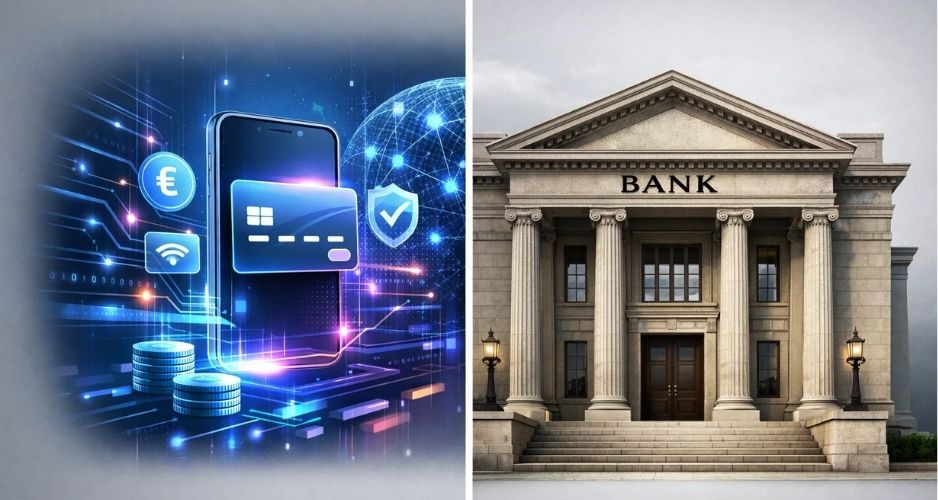
The differences between a bank and an EMI can significantly impact an international business’s time to onboard, ability to make flexible payments abroad, efficiency of complying with regulatory requirements, cost of doing business internationally, and ultimately the likelihood of successfully completing international transactions.
This guide provides information about how banks and EMIs function and also details which organization is better suited for specific types of businesses, along with information that businesses should review prior to opening an account in 2026.
Key Takeaways
- Both banks and EMIs can offer accounts and payment processing, but they operate under different licences.
- Only banks can lend money, and only banks can use deposits (that is, use other people’s deposits to fund their loans).
- EMIs hold funds; they generally don’t accept deposits.
- Most deposit protection schemes (for example, if your money is stolen) only apply to accounts held with banks.
- EMIs are typically faster than banks and have more flexibility for cross-border payments.
- The short of it is, if you need credit or a guarantee on your deposit, you’ll need a bank. If you want operational ease and a speedy payment, go for an EMI.
What Is a Bank?
The traditional banking model works by taking funds from one source and passing them to another. Specifically, a bank is a financial institution that accepts deposits, lends money for a fee, invests funds, and handles transfers of money.
A typical bank will do a range of services:
- Bank accounts (such as checking and savings accounts)
- Loans (including mortgages) and credit (such as credit lines)
- Payments (such as wire transfers, debit cards, auto-pay)
- Investments (such as managed assets)
Simply put, banks don’t just keep your money; they use it to make money themselves.
How banks actually work
The truth is, when you make a deposit at your bank, it does not merely store the funds in a safe. Your bank may utilize your funds to provide loans to customers, to purchase investments, etc. This is how banks generate their revenue, and, for the most part, it is how banking has always functioned.
This system of banking is heavily regulated, and banks are required to keep funds in reserve, as well as abide by numerous other requirements and regulations that comprise financial oversight.
Regulation and protection
Banks provide their users with one key benefit: protection. A deposit account is almost always covered either by deposit insurance or some other deposit guarantee mechanism across the vast majority of jurisdictions.
What Is an EMI (Electronic Money Institution)?
Electronic money institutions (EMIs) are financial service providers, but unlike a traditional bank, EMIs do not provide loans to the general public. Their core products focus on payments, transfers, and e-money issuance.
The services provided by EMIs may include:
- Payment accounts (IBANs or wallet accounts)
- Payment execution (payments), transfers (payments)
- Cross-border transfers (transfers)
- Multi-currency accounts
- Cards issuance & processing services
In general, EMIs operate as fintechs and digital businesses. One particular use case is for global businesses that often have to deal with foreign exchange issues.
What EMIs don’t do
An EMI isn’t able to:
- Issue loans from its clients’ money
- Offer traditional banking credit products
- Take deposits for its investment operations
Though offering loans may seem like a drawback, it is, in reality, a deliberate strategy.
Safeguarding vs deposits
The customers’ funds with an EMI are safeguarded and do not amount to a deposit.
Practically, it means:
- The company will keep the funds of customers with them in a separate account from its own money.
- The funds may even be in an external bank that is duly licensed.
- The EMI cannot use these funds for running the company or for any of its activities.
This process is a strategy designed to keep risk in check, but it also results in a significantly different operating environment compared to a bank.
Bank vs EMI: Key Differences Explained
Here’s a clear side-by-side comparison:
| Feature | Bank | EMI |
| License | Banking license | EMI license |
| Lending | Yes | No |
| Deposits | Yes | No (safeguarded funds) |
| Deposit protection | Yes (in most cases) | No |
| Use of funds | Can lend and invest | Cannot use client funds |
| Onboarding speed | Slower | Faster |
| Core use case | Full financial services | Payments & operations |
This table captures the core idea: banks are built for financial intermediation, while EMIs are built for the movement and management of money.
How EMIs and Banks Are Regulated
The key difference between the two, in terms of regulation, can be identified through their respective authorisation structures.
Banks in the U.K. are authorized via a banking licence that subjects them to supervision of both the Financial Conduct Authority (FCA) and the Prudential Regulation Authority (PRA). As such, banks have permission to accept deposit liabilities, provide loan facilities, and utilize customer deposited monies for lending and investment activities, subject to stringent capital and reserve requirements.
By contrast, EMI’s are regulated via authorization under the Electronic Money Regulations 2011, and generally are used for providing payment services and issuing electronic money, not for lending.
As EMI’s do not utilize customer monies for lending or investments as banks do, customer deposits are required to be segregated for safety and may be held at a licensed partner bank.
Within the EU, both electronic money institutions and payment institutions have been established under PSD2 and the electronic money directive(s), and overseen by regulators like the European Banking Authority (EBA).
Differences in regulatory compliance for international businesses, fintech companies, etc., along with differing requirements for onboarding and payment options between banks and EMIs, make it essential to consider this distinction when establishing a new operation.
How EMIs Work in Practice
Understanding why EMIs have become such a hot sector requires a deeper look into how they operate.
In general, the workflow works like this:
- Set up an EMI account
- Deposit money
- The EMI custodies the funds (many EMI operators partner with a locally based commercial bank that holds the account)
- Use the account to pay or get paid, and also transfer the funds to other account
In the consumer’s eyes, an EMI can look and feel like any other bank account: with an account number, a debit card, and the ability to pay and receive. But the underlying systems are actually very different.
Real-world example
Let’s say you own a SaaS business with customers in the US, Europe, and Asia. With a traditional bank, accepting multiple currencies and conducting international payments can be both cumbersome and costly.
Using an EMI allows you to:
- Accept payments in multiple currencies
- Keep multiple currency accounts active for future use
- Send payments internationally in real time
That’s where EMIs have a competitive advantage over traditional financial services.
When to Use a Bank vs an EMI
It really boils down to your specific requirements rather than finding a definitive “superior” option.
When a bank makes more sense
Generally, if you require loans, access to credit facilities, or financing, banking offers you a better alternative.
A bank is the right route when you:
- Require loans, credit lines or finance facilities.
- Want the protection of deposit protection.
- Require your deposits or long-term investments
- Want a more traditional banking
When an EMI is the better choice
Usually, if you require international or online trading capabilities, an EMI may be best option.
An EMI might be best when you:
- Conduct international or online trading.
- Handle multiple currencies
- Wish to onboard quickly.
- Desire fewer restrictions
- Don’t need to borrow
- Wish to have operational flexibility
Many international businesses now use both traditional banks and EMIs simultaneously – banks for financing, lending, and reserves, and EMIs for operational payments, international transfers, and multi-currency account management.
This hybrid approach has become increasingly common among international companies, startups, e-commerce businesses, and firms handling cross-border transactions.
Why Do International Businesses Choose EMIs?
EMIs have become very appealing to the increasing number of foreign-based business operations that need rapid onboarding processes, operate in multiple currencies, and/or make quick, cost-effective cross-border transactions.
Compared to traditional banking institutions, EMIs offer much greater flexibility to businesses that are based internationally – especially those whose employees work remotely, generate online revenue, or serve clients from various countries/jurisdictions.
Common examples of businesses that use EMIs as part of their financial infrastructure include:
- Software as a service (Saas) companies
- Online e-commerce merchants
- Companies involved in import/export
- International consulting services
- Digital marketing/agency services
- Cryptocurrency-related businesses
- Startups that function completely as “remote-first” entities
- Marketplaces
Are EMIs Safe?
Yes, with some minor nuances.
One of the many questions that people ask us about opening a new EMI account is “are these safe?” And while it’s a great question, it’s also one of the best questions you can ask.
However, how banks treat EMIs differs from licensed EMIs in terms of protecting customer funds. Licensed EMIs are generally safer for operations and global business than regular banks. However, licensed EMIs do not protect customer funds in the same manner as traditional banks. Banks typically protect eligible customer deposits through government-backed deposit protection programs.
In the UK, this would include the Financial Services Compensation Scheme (FSCS) that will protect eligible customer deposits up to specific amounts. EMIs have no similar protections for their customers. Customer funds that are held by EMIs cannot be classified as deposits.
Therefore, EMIs must segregate customer funds from operational company funds. The purpose of segregating customer funds is to minimize the potential loss of customer funds should the EMI experience financial distress.
Banks offer deposit protection, while EMIs offer safeguards.
They are different things.
In the event that a bank goes under (or ‘dies’), your money is protected through the deposit protection scheme to a certain extent (and in accordance with certain other rules that we won’t go into in this article)
With EMIs, in the event that the EMI were to die, your money still should be protected, but it’s protected in a different and sometimes more complex way, as opposed to the deposit protection mechanism, which has more standardised rules associated with it.
Risks and Limitations of EMIs
EMIs may be flexible, but not without their own drawbacks.
Among the key challenges are:
- No deposit protection schemes
- Minimal access to credit or lending
- Potential for restricted transactions (e.g. in cases of compliance-related activity)
- Reliance on partner banks for customer deposits protection
While these may not put off many, it’s important that these risks are clearly understood.
Real-World Scenarios
Scenario 1: Traditional business using a bank
The bank is a good fit for a company based in one country, which has a fairly steady cash flow and funding needs. It could take out a loan, use overdraft facilities, or use the bank to raise longer-term funding and be content with this for their needs.
Scenario 2: Global startup using an EMI
One Poland-based crypto payments company working with clients across Europe and Asia initially relied on separate banks, crypto exchanges, and fintech platforms to process transactions in euros, US dollars, and USDT. As transaction volumes increased, the business began facing delayed transfers, repeated compliance reviews, and restrictions linked to crypto-related activity.
To simplify operations, the company moved to a UK-based multi-currency fintech banking setup supporting both fiat and crypto-related transactions within a single environment. Our team at Q Wealth helped reduce payment delays, streamline compliance procedures, lower transfer costs, and improve international payment management.
The case reflects a broader trend in 2026, where international businesses increasingly combine traditional banking infrastructure with EMI solutions for greater operational flexibility.
How to Choose Between a Bank and an EMI
So, how do you choose a bank or an EMI?
Ask yourself the following:
- Do you require credit or loans?
- Does your customer base extend overseas? Does your income stem from multiple countries?
- Is speed and flexibility important to you?
- Do you require government deposit protection?
- Will you be handling multiple complicated transactions and payments?
For most, the answer is neither. Both will be your solution.
Summary
Banks and Electronic Money Institutions (EMIs) may appear similar in their payment functionality; however, at their core, they are two entirely different types of financial institutions that serve vastly different purposes.
The primary function of traditional banks is to provide loans, receive deposits, facilitate credit, and establish long-term financial infrastructure. On the other hand, electronic money institutions specialize in providing payment services, facilitating multi-currency transactions, and rapidly moving international funds. Additionally, EMIs maintain separate accounts for customers’ funds from those used by the company for its own operation.
By 2026, most international businesses will be using both; banks for establishing and maintaining financial stability and obtaining financing and EMIs for quicker onboarding processes, operational flexibility, and rapid payment processing across borders. Understanding the key differences between banks and EMIs will become increasingly important for new start-ups, online businesses, and foreign-based companies wishing to expand globally.
Frequently Asked Questions
Is an EMI the same as a bank?
No, they are not the same. Both have accounts, payment facilities etc. But the bank can also lend and take deposits. An EMI cannot – it will make payments and provide some form of protection.
Are funds in an EMI protected?
Yes, in a manner that is slightly different than a bank protecting your deposits. An EMI protects your money instead.
Can an EMI hold large balances?
Many businesses have large balances in EMIs, usually related to international business transactions. It is very important to understand the rules and restrictions regarding safeguarding.
Why are EMIs faster than banks?
An EMI is a digital product (onboarding is faster, payments are faster, and there’s more flexibility with systems).
Do businesses need both a bank and an EMI?
Many companies do have both, for example, using a bank for stability/credit and then an EMI to pay bills around the world.
